Project APTAMERE: Reconstructing Dietary Systems Following the Collapse of the Roman Empire
Principal Investigator at ZRC SAZU
Izr. prof. dr. Benjamin Štular-
Acronym
APTAMERE
Project Team
Edisa Lozić, PhD, Asst. prof., Maša Kavčič, Lea Legan, Dr. Andrej Magdič, Dr. Klara Retko, Dr. Polonca Ropret-
ARIS Project ID
J6-70221
-
Duration
1 March 2026–28 February 2029 -
Lead Partner
Institute for the Protection of Cultural Heritage of Slovenia, Conservation Cen…
-
Project Leader
-
Financial Source
Slovenian Research and Innovation Agency - ARIS

Partners
Institut "Jožef Stefan"
The Central Archaeological Challenge: Dietary Shift
This project explores the profound agricultural and social transformations that followed the collapse of the Roman Empire. The Roman dietary system was heavily reliant on the organized production and distribution of wheat. With the disintegration of these structures, populations were forced to adapt their farming practices to new economic and environmental realities.
Project APTAMERE utilizes cutting-edge biochemical analysis directly on archaeological pottery shards to verify how this transition manifested in daily life.
Key Research Hypotheses
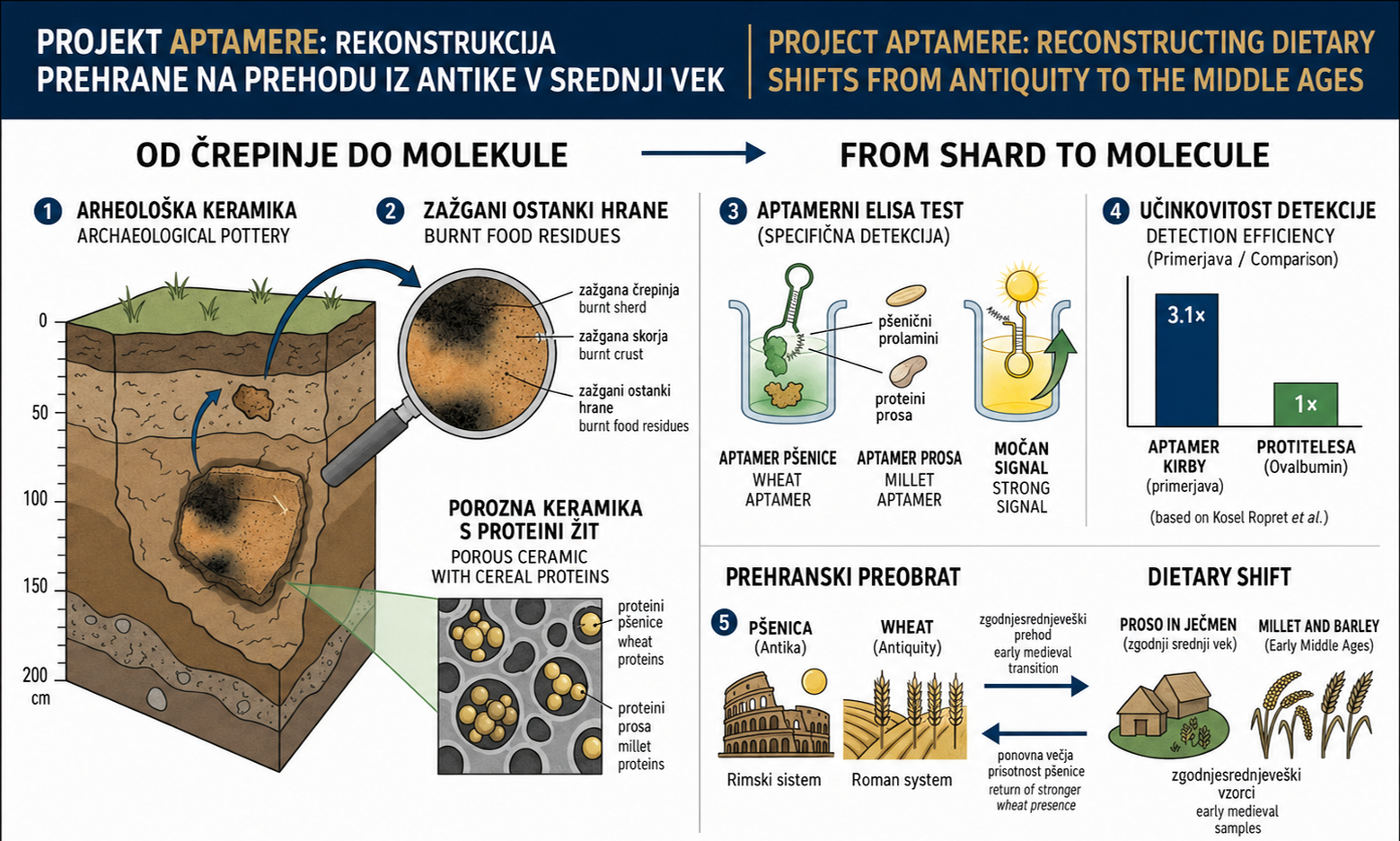
- Slavic Settlement and Food Security: We investigate whether Slavic immigrants in the 6th and 7th centuries introduced a more resilient, self-sufficient agricultural system based on barley and millet instead of wheat. Such innovation may have prevented a total population collapse following the end of Antiquity.
- The Avar Agricultural Revolution (Post-626 AD): We examine whether the Avar Khaganate, following their military defeat at Constantinople, fundamentally restructured their state into an agrarian entity. A key indicator of this shift would be the reintroduction of wheat cultivation, adopted from the remaining Late Antique population.
Why Analyze Pottery with Aptamers?
Ceramic vessels are the most abundant finds in the archaeological record and directly reflect past culinary practices. Traditional methods for identifying plant residues are often imprecise or cost-prohibitive.
Project APTAMERE introduces the use of DNA aptamers—small synthetic molecules that act as specific "keys" to recognize cereal proteins. Due to their low molecular weight (~ 8kDa), aptamers penetrate deep into the pores of the ceramic where food residues are trapped.
Experimental results have shown this method to be over three times more effective at detecting ancient residues than standard antibodies.
By integrating archaeological finds with biochemical precision, we aim to provide the first direct evidence of when and why wheat gave way to millet, and the subsequent return of wheat to the agricultural landscape.