12
FEB
10:00
Two lectures on the latest (2025) discoveries on the Danube Limes
February 12, 2026 at 10:00 to February 12, 2026 at 11:30
Atrij ZRC, Novi trg 2, Ljubljana
The ZRC SAZU Institute of Archaeology invites you to two lectures on the latest (2025) discoveries on the Danube Limes.
Research in Stein-St. Pantaleon-Erla / Claudivium(?) in Austria will be presented by Barbara Kainrath and Gerald Grabherr from the University of Innsbruck, while research near Mohovo in Srem, Croatia, will be presented by Marko Dizdar and Siniša Krznar from the Institute of Archaeology in Zagreb.
The lectures will take place on 12 February 2026, at 10 a.m. in the Atrium of ZRC SAZU, Novi trg 2. You are cordially invited!
***
The predominantly military Roman settlement site of Claudivium(?)/Stein-St. Pantaleon-Erla
Gerald Grabherr and Barbara Kainrath (University of Innsbruck)
In Stein/St. Pantaleon-Erla on the Danube valuable insights were made as result of the Circum Lauriacum research network regarding this region of strategic importance in Roman times. In the summer of 2025, geophysical surveys by GeoSphere Austria led to the discovery of a timber-and-earth fort, while at the same time the University of Innsbruck carried out its first archaeological excavations in the more recentiary stone fort. This has provided a better understanding of the military development of this Roman army garrison. However, the shape and structure of the site raise new questions about the development of this border region during the Marcomannic Wars.
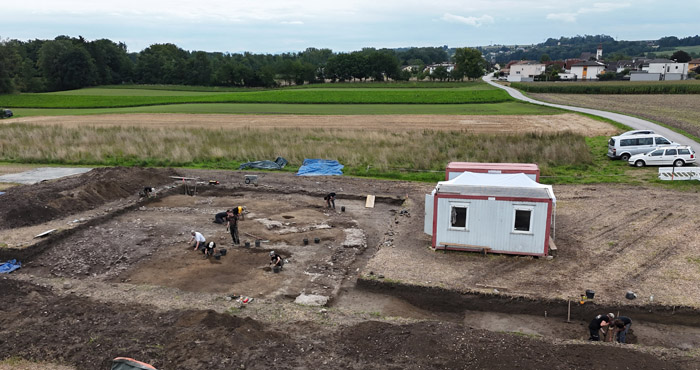
Excavations on the fort Claudivium(?) on the Danube
***
Results of research on the watch tower in Mohovo (Srem) on the Roman Limes
Marko Dizdar and Siniša Krznar, Institute of Archaeology in Zagreb
In order to prepare the Danube Limes for inclusion on the UNESCO World Heritage List, the Institute of Archaeology (Zagreb, Croatia) began archaeological excavations on the limes in the Vukovar-Srem district (eastern Croatia) in 2020. Based on written sources and epigraphic monuments, it is known that there were fortifications in Sotin (Cornacum) and Ilok (Cuccium) where military units were permanently stationed, including watchtowers. First, a field survey was conducted in the area along the Danube from Borov to Ilok, during which many sites from many periods were discovered. At the sites where finds from the Roman period were discovered, geomagnetic surveys were carried out. They identified structures that are believed to be the remains of watchtowers.
To date, eight such structures have been discovered at the edge of the embankment above the Danube. In order to document the larger area of one of the watchtowers, research was carried out between April and July 2025 on the watchtower located east of the village of Mohovo. The results showed that the observation post was built in several phases and that it was probably a wooden structure surrounded by deep V-shaped ditches. The remains of ditches from a later phase were also identified, the purpose of which will be investigated in 2026. Metal and ceramic artefacts discovered in the excavated ditches date the remains of the watchtower to the second half of the 2nd to the end of the 3rd century. After the excavations are completed, the site will be preserved and presented as part of the cultural offer of the Croatian Danube region.
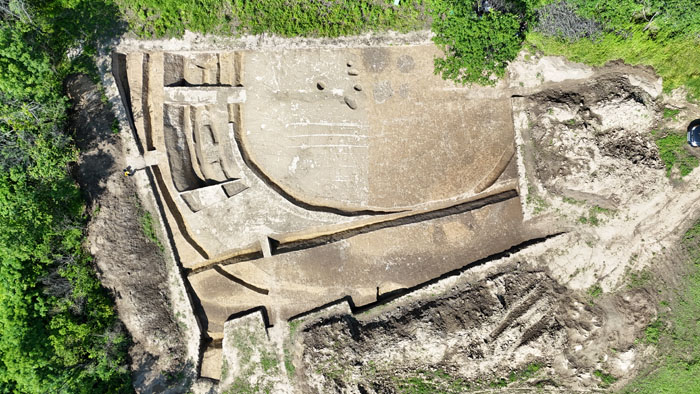
Watch tower in Mohovo